
Junming Huang
Research Scientist, Princeton University
As a computational social scientist, I'm attracted to the complex dynamics of human behaviors: tracking the formation and evolution of human opinions under media and peer influence, and examining how gender and racial identities affect scientific careers and leads to population-level disparities. Utilizing large-scale data, my research employs statistical methods such as machine learning, network analysis, and natural language processing to turn behavioral traces into actionable insights.
Science of Science
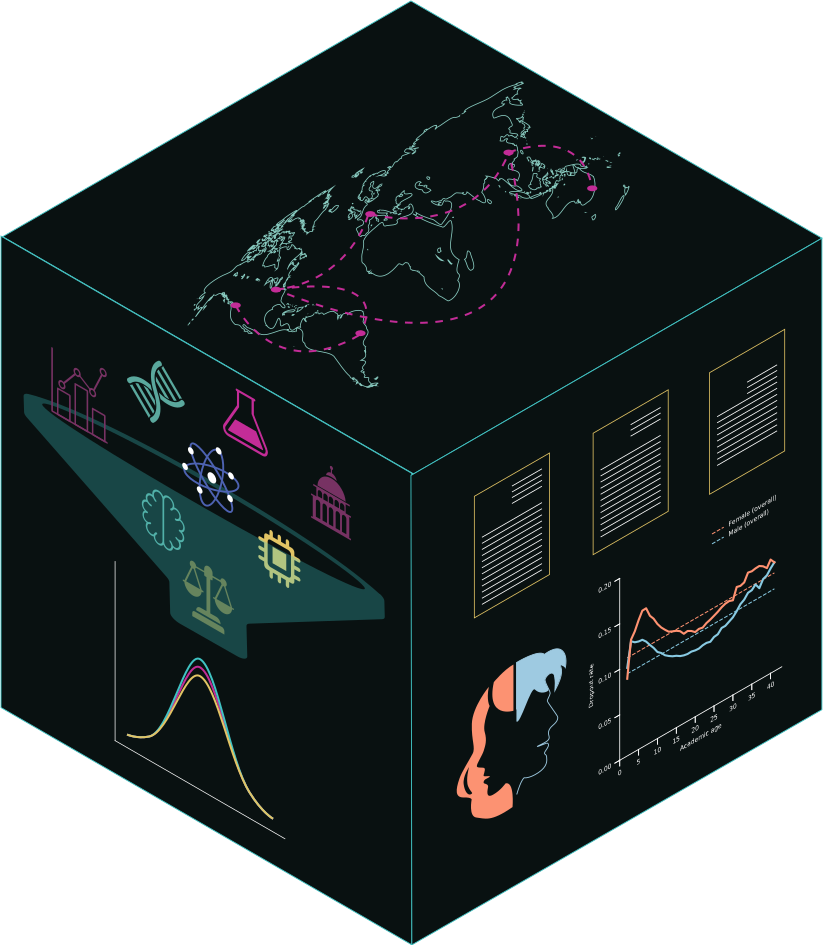
The field of Science of Science is dedicated to quantitatively deciphering the universal patterns driving scientific discoveries using extensive bibliometric data, with an aim to offer insights for fostering academic progress. My research delves into disparities within academia, a realm complicated by interplaying factors such as discipline, country, and institutional prestige. By reconstructing detailed career trajectories of scientists from bibliometric data, I tackle this complexity for in-depth explanation of gender inequality and impact of scientist nationality. Those findings have been featured in PNAS and have garnered media attention from Nature Index, Associated Press, and The Wall Street Journal. Click here to read more.
Human Opinions and Peer Influence
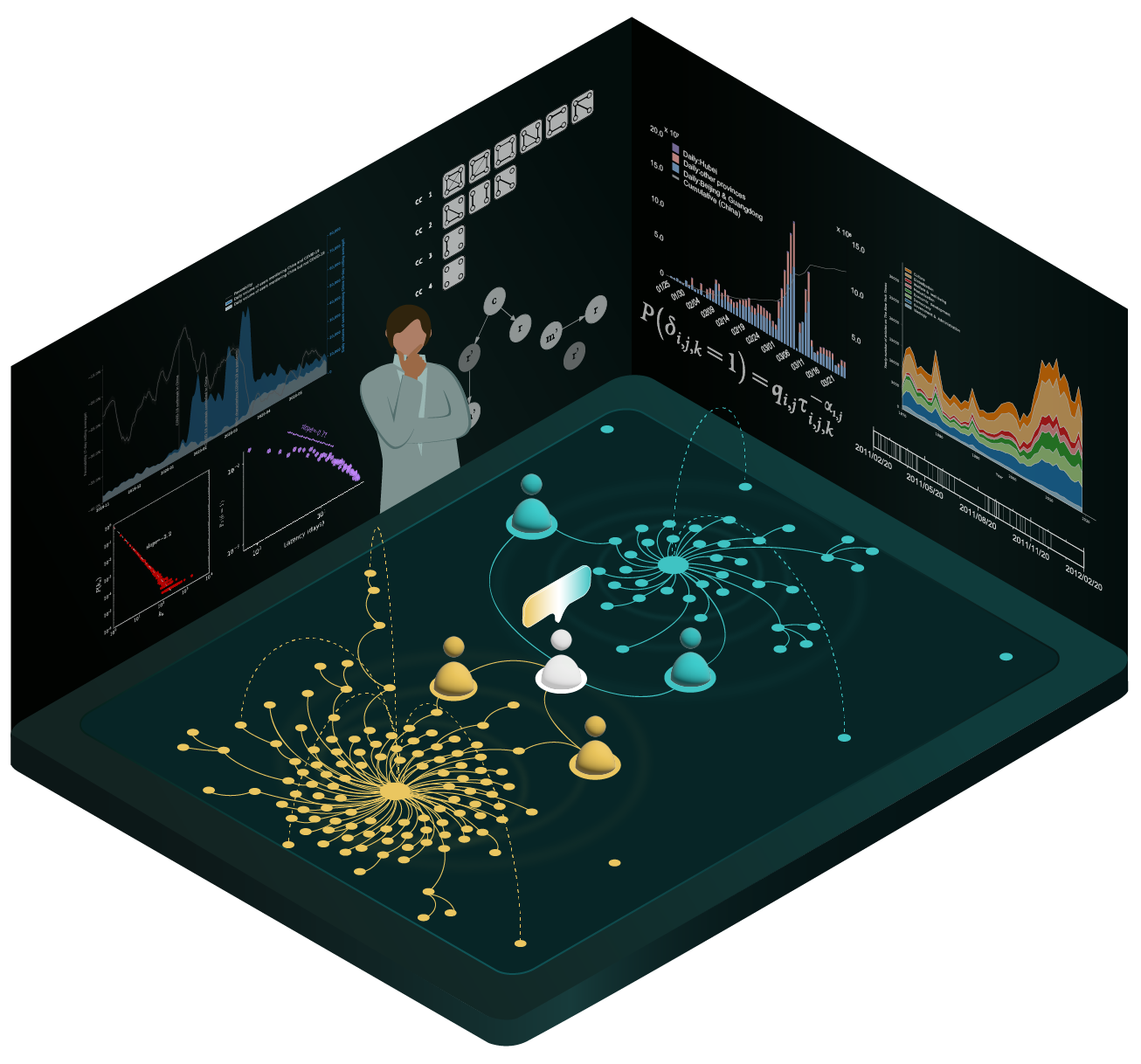
Human opinions are important in social norm discussions and complicated in dynamics. In the era of explosive usage of social media and social networks, human online behaviors are influenced by close friends and opinion leaders, referred to as peer influence. The recent availability of large-scale online opinion data provides rich resources to observe and understand human opinions, from trending to scaling, from mobility to proximity, from the reaction to external shocks to the consequences on physical space behaviors. Read more
Probabilistic Modelling and AI
Everything has a chance, both in the phenomena we study and in the tools we use to study them. In this line of research, we develop and apply probabilistic models to understand complex scientific and social systems. Methodologically, our work draws on causal inference, latent-variable models, probabilistic matrix and tensor factorization, Bayesian networks, network analysis, and time-series methods to represent uncertainty, structure, and dynamics in data. Substantively, we explore how probabilistic models, including modern AI systems, apply to and shape the real world, examining their impacts on education and natural language use, AI-assisted research in the natural and social sciences, as well as applications such as recommender systems, virus epidemics, and survey harmonisation. A unifying goal is to understand how probabilistic modelling and modern AI, particularly large language models, can support inference, reasoning, and discovery across disciplines. Read more

Press Highlights






Events
Special Issues calling for papers: Chinese Journal of Sociology and Frontiers in Psychology.